An AI workspace for vehicle definition
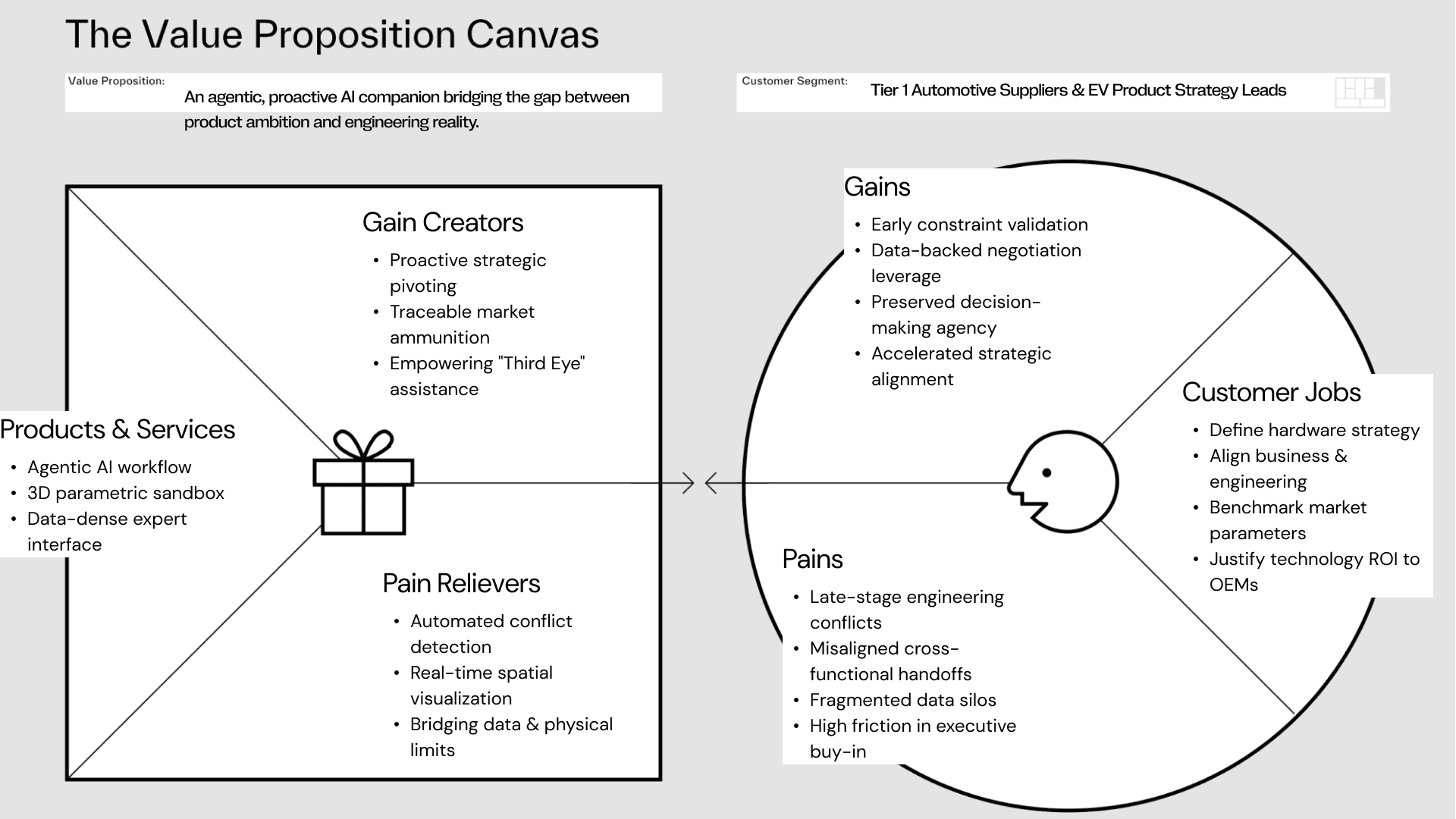
VARRAY helps automotive product teams turn market ambition into a vehicle concept that engineering can actually build.

Role
Product Design, UX, Vibe-coding
Timeline
5 Weeks
Tools
[Figma, Cursor, Claude]
Platform
Web, desktop
Overview
An AI workspace that checks a vehicle concept against physical limits, so product teams catch conflicts while changes are still cheap.
Concept project, inspired by my PM internship at a leading China EV company.
The problem
Product ambition is set on paper. Engineering reality shows up months later.
PMs lock a car’s dimensions in a PRD long before engineers can check whether they physically work.

Where VARRAY sits: the concept phase, before requirements are locked.
Key findings
From my internship, three things kept slowing concept work down
Insight 01
Concept cycles are short
PMs lock critical dimensions in months, with no room for late fixes.
Insight 02
Feasibility lives in engineers’ heads
Checking feasibility depends on individual engineers, so every answer takes a meeting.
Insight 03
Specs on paper hide physical conflicts
A PRD can’t show which target spec will cause a hardware clash.
The design problem I worked on
How might we help product teams test a vehicle concept against real physical limits, so conflicts surface in the concept phase, not after sign-off?
Who it’s for
Vehicle Product Manager
Turns market demand into a final PRD.
Vehicle Engineer
Sets the physical guardrails.
Strategy Researcher
Keeps decisions tied to market data.
Key solutions
Following Daniel through one decision
Daniel, a vehicle PM, wants to know if a 5.6-meter flagship sedan can work in the city without losing its presence.
#01 · Benchmark
Start from the requirements you already have
Problem
Benchmarks start from scratch, in scattered spreadsheets.
Solution
Import the PRD. VARRAY turns it into comparable parameters and picks the right competitors.


#02 · Visualize
See the spec as a car
Problem
5,612 mm means little until you can see it.
Solution
Specs become an interactive 3D car, compared against the competition.


#03 · Simulate
Test a trade-off before it gets expensive
Problem
A shorter wheelbase has knock-on effects you can’t see on paper.
Solution
VARRAY flags chassis conflicts the moment a value changes.


#04 · Explore
Let AI find another way
Problem
Changing the proportions would cost the car its presence.
Solution
AI suggests rear-wheel steering, then researches it and builds a report.


#05 · Decide
Prove it, then lock it in
Problem
Leadership needs proof before committing to new hardware.
Solution
Simulate RWS in the sandbox, then lock in the design.

Process
[From a PM pain point to a working prototype]
[One or two sentences on your process.]
[01 · Framing the problem]
[02 · Mapping users and the concept phase]
[03 · Vibe-coding the 3D sandbox]
Design challenges
[Two decisions that shaped the product]
Challenge 01
[How much should the AI say when it flags a conflict?]
[One sentence of context.]
[Initial design]
Initial design — [what changed]
[Refined design]
Refined design — [what changed]
[Final design]
Final design — [what changed]
Challenge 02
[How do you make a spreadsheet number feel physical?]
[One sentence of context.]
[Initial design]
Initial design — [what changed]
[Refined design]
Refined design — [what changed]
[Final design]
Final design — [what changed]
How the AI works
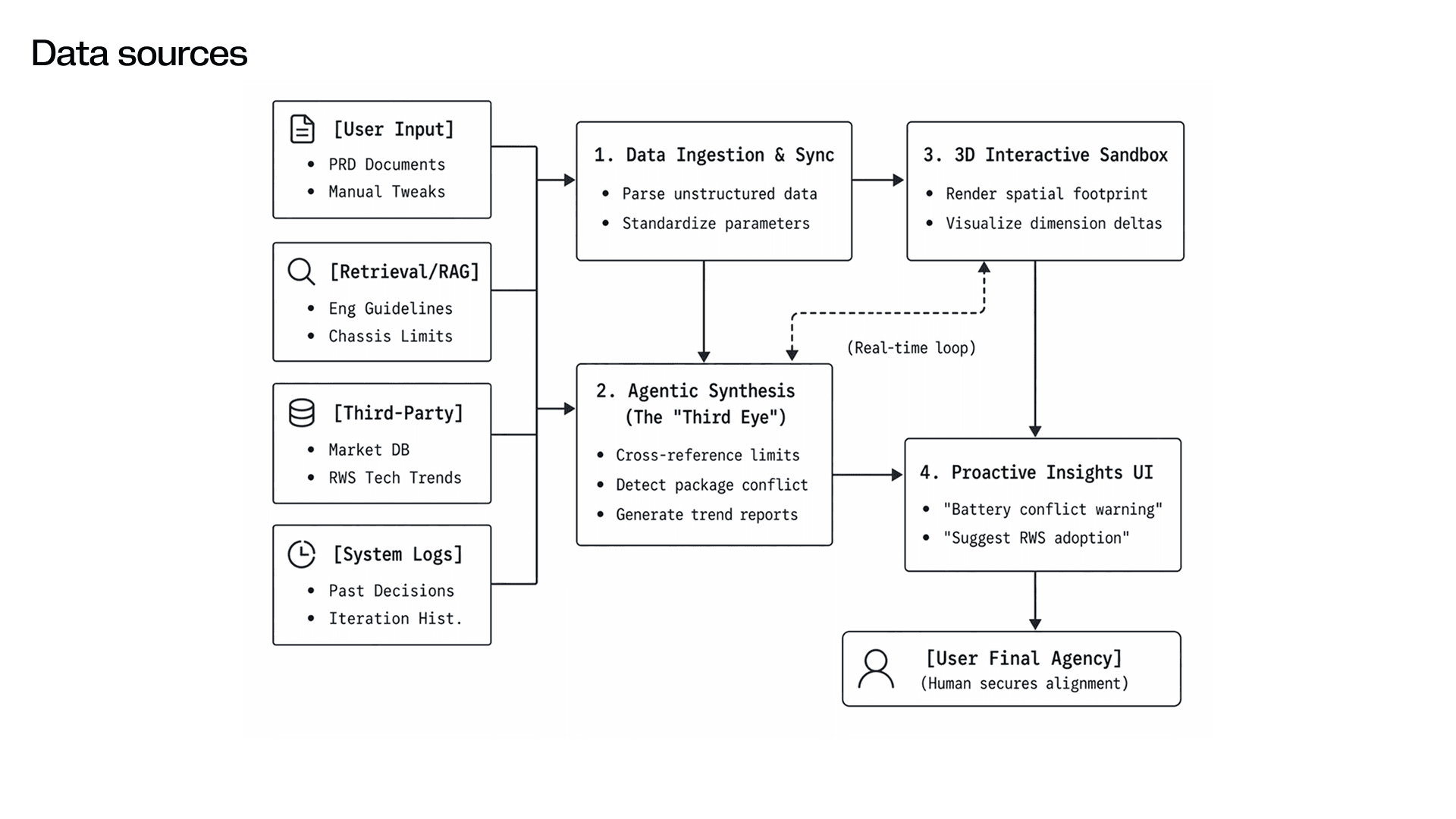
A third eye, with the human in charge
Principle 01
Check every change against real limits
Every change is cross-checked with engineering rules and market data.
Principle 02
Suggest, never decide
AI proposes, the PM decides. Every insight is traceable.


Evaluating the AI
A rubric before the interface
I wrote golden queries and acceptance criteria first, then scored every response.
4 golden queries
Fact-based
Compare second-row headroom, legroom, and wheelbase: Model S vs. Lucid Air Pure.
Qualitative
Top 3 Reddit complaints about Lucid Air cabin quality and noise, vs. Model S.
Agentic workflow
Build a Model S vs. Lucid Air comparison matrix and export it to CSV.
Strategic synthesis
Which car wins on rear-seat comfort in the $70k EV segment, and where do both fall short?
4 acceptance criteria
Retrieval
Numbers match official specs.
Tools
Calls the right tool for the intent.
Reasoning
Turns dimensions into real-world impact.
Usefulness
Moves the PM toward a decision.
Scoring responses against the rubric

Takeaways
What I learned building VARRAY
[Takeaway one.]
[e.g. what vibe-coding changed about how you design.]
[Takeaway two.]
[e.g. what writing an AI rubric taught you.]
[Takeaway three.]
[e.g. designing for PMs and engineers at the same table.]
[Takeaway four.]
[One or two sentences.]
If I had more time
Business model & value proposition
[What you would explore next, and why.]